During Erasmus Days 2026, on Thursday the 15tFrench companies are largely convinced of the value of international mobility for apprentices, and a majority say they are ready to get involved. This is the main finding of the survey conducted by Ipsos for Euro App Mobility among 300 employers, presented at the TEAA conference (Towards the European Apprenticeship Area) on 15 October 2026. But several obstacles must still be removed to turn intention into action: salary costs, length of absence and organisation.h of October, Euro App Mobility brought together various stakeholders in international apprentice mobility at the French Ministry for the Economy and Finance for the conference “Towards the European Apprenticeship Area” (TEAA). Held under the high patronage of the President of the French Republic and opened by the French Minister of Labour, Jean-Pierre Farandou, the day led to the adoption of a joint declaration titled “Towards the European Apprenticeship Area”.
Commissioned by Euro App Mobility, the survey was funded by OPCO EP, Afdas, Opcommerce, Constructys, OPCO Mobilités, OPCO 2i, OPCO Atlas and Ocapiat, as well as by AFT and CESI.
Employers are convinced
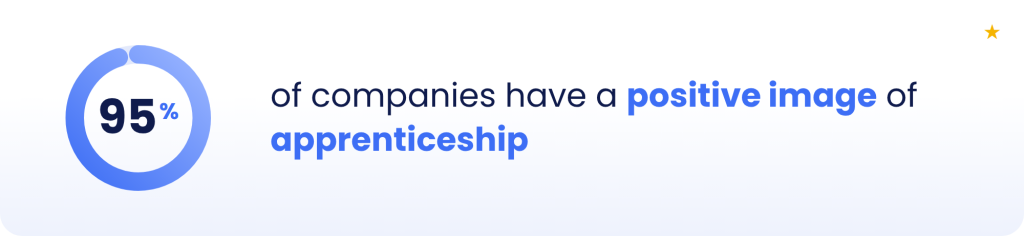
Apprenticeship enjoys a remarkable level of trust: 95% of the companies surveyed have a positive view of it, and 74% employ or have employed an apprentice. For 93% of them, international experience is an integral part of training, and 87% consider mobility relevant for apprentices in higher education.
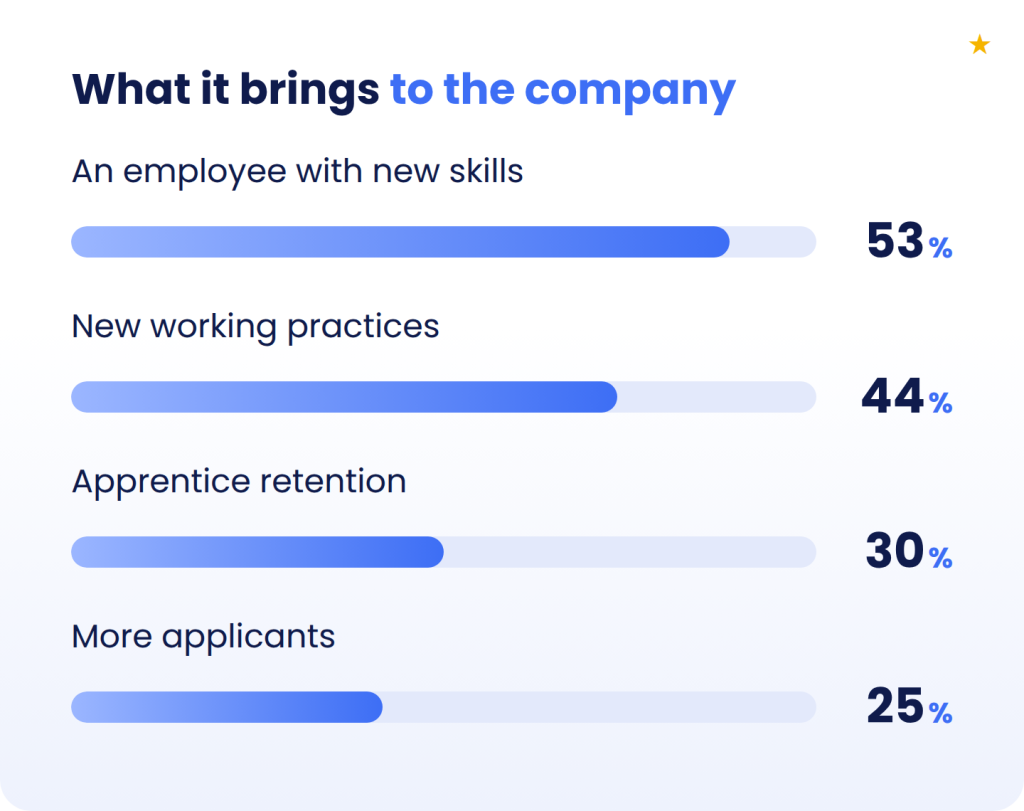
Employers identify concrete benefits, both for themselves and for their apprentices.
European mobility of apprentices
Unsurprisingly, international mobility benefits the apprentice. But more importantly, it also benefits the company that employs them.
A majority of companies open to their apprentices’ mobility
Today, 13% of companies already send their apprentices abroad. But many others are ready to do so: in total, 68% of employers already allow it or could allow it. This openness is even more pronounced in large companies, reaching 86% among those with 250 or more employees.
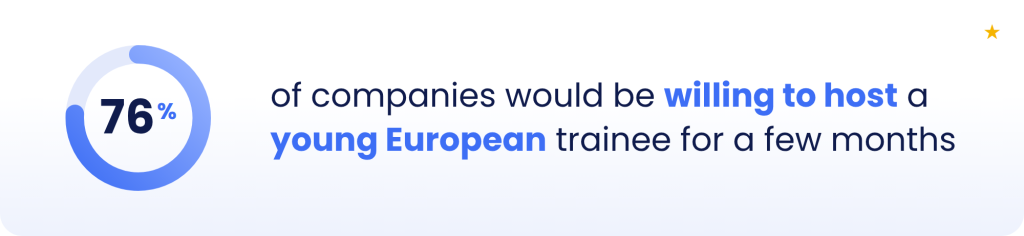
Reciprocity is also well received: 76% of companies would be willing to host a young person from another European country for a few months. And 90% believe that mobility makes a company more attractive to young people, a strong argument at a time of recruitment difficulties.
Awareness still needs to be built
There is nevertheless still some way to go in making employers aware of apprentice mobility. Just over half of the employers surveyed (56%) currently know that an apprentice can complete part of their training abroad. Funding tools are also only partly known: 60% know that OPCOs (sector skills operators) can fund mobility, and 47% that apprentices are eligible for the Erasmus+ programme. Companies with substantial international activity are the best informed: 77% of them are aware of this possibility.
Concrete obstacles to overcome
While support is broad, taking action runs up against perceived operational constraints that often do not reflect reality. Even so, 75% of companies consider an apprentice’s departure hard to reconcile with their business, a figure that rises to 83% in industry and construction.
- Duration: 43% of employers will not accept more than one month of absence. The most frequently cited maximum is in fact three to four weeks (27%).
- Salary costs: the main barrier. 72% of companies are willing to cover the apprentice’s salary during a two-to-four-week mobility. This falls to 60% for one to three months, and 44% beyond three months. The smallest organisations are the most exposed: beyond three months, only 32% of companies with 6 to 9 employees are willing to do so. For a two-to-four-week mobility, 64% of micro-businesses are willing to fund it, compared with 85% of companies with 250 or more employees.
- Organisation: Half of employers (50%) prefer to suspend the contract during the mobility, leaving the host organisation or the apprentice training centre (CFA) to provide supervision and material support for the project. One encouraging point, however: 34% of companies would opt to maintain pay (that is, a secondment arrangement), a share that reaches 46% among companies with more than 250 employees. Finally, 24% expect clear guarantees regarding insurance and social security coverage.
A growing number of CFAs are going international, and departures are increasing. But the mobility rate remains below target. Jean Arthuis stressed the issue of reciprocity: seen from France, incoming mobility remains far lower than outgoing mobility. He urged CFAs to make use of the 2023 law to host foreign apprentices for periods longer than two months.
The levers employers are looking for
Asked what would encourage them to take the plunge, companies cite first and foremost compensation for salary costs (39%), the CFA handling the administrative procedures (34%), choosing a period compatible with their business (31%) and guaranteed learning objectives (27%).
By mapping employers’ perceptions, this survey highlights both what has been achieved and the road still ahead. The support is there; the task now is to remove the obstacles that still hold back action, so that international mobility becomes a fully accessible right for every apprentice and a firmly established practice for companies.
This is the ambition Euro App Mobility has pursued since its founding in 2020, through its day-to-day work with CFAs and companies, its programmes such as Mona and MOBLT, and now the European Employers’ Club, which brings together committed companies at European level.